In an era where the average student checks their phone 150 times per day and switches between tasks every 19 seconds, the ability to focus deeply has become both increasingly rare and increasingly valuable. While your peers struggle with fragmented attention and shallow learning, mastering deep work can give you a significant academic advantage that compounds over time.
Understanding Deep Work: Beyond Simple Focus
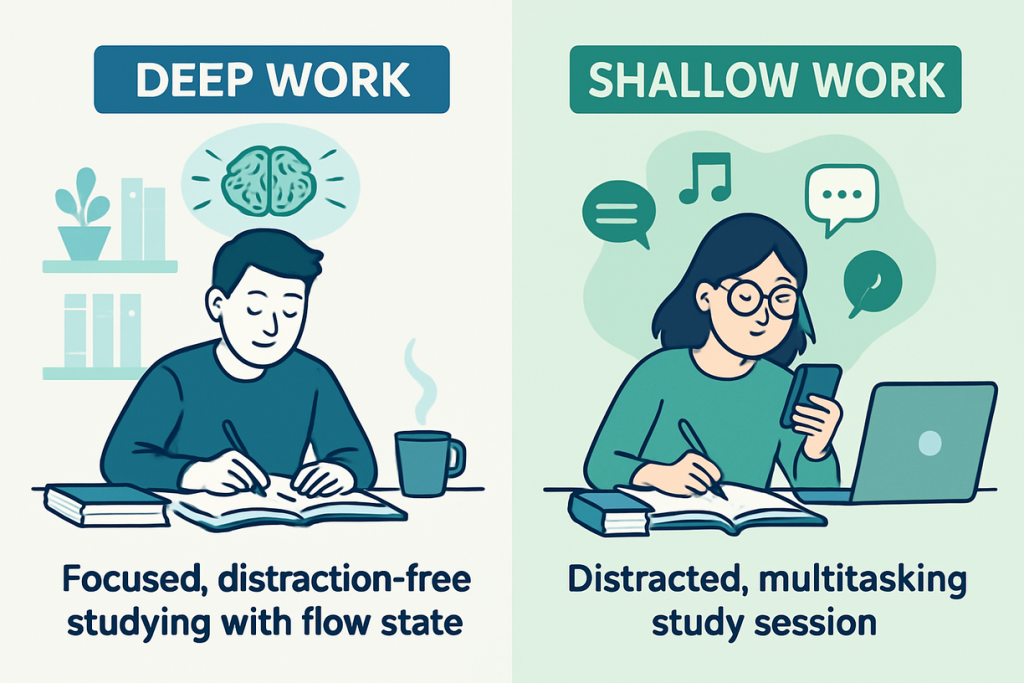
Deep work, a concept popularized by computer scientist Cal Newport, refers to professional activities performed in a state of distraction-free concentration that push your cognitive capabilities to their limit. For students, this translates to sustained periods of focused learning that produce high-quality understanding and retention.
Deep work differs from regular studying in several crucial ways:
Cognitive Intensity
Deep work requires your full cognitive capacity, engaging complex neural networks that strengthen with practice. This isn’t passive reading or mindless note-taking—it’s active, demanding mental effort that builds intellectual muscle.
Sustained Duration
While shallow work can be done in fragments, deep work requires extended periods—typically 90 minutes to 4 hours—to reach peak effectiveness. This duration allows your brain to fully engage with complex material without the startup costs of constant task-switching.
Distraction-Free Environment
Deep work demands complete isolation from interruptions. Even the mere presence of a smartphone, even when silenced, can reduce cognitive performance by up to 10% due to “brain drain”—the mental resources devoted to resisting the urge to check it.
Value Creation
The output of deep work sessions isn’t just completed assignments—it’s genuine learning, creative insights, and the development of expertise that shallow work cannot produce.
The Neuroscience of Deep Focus
Understanding how your brain responds to deep work can help you optimize your approach:
Myelin and Skill Development
When you practice deep work, your brain strengthens the myelin sheaths around neurons involved in the focused activity. This biological change literally makes you faster and more efficient at complex cognitive tasks.
Default Mode Network
During deep work, your brain’s default mode network—responsible for mind-wandering and self-referential thinking—becomes less active. This neurological shift allows for greater absorption in the task at hand.
Flow State Physiology
Deep work often triggers flow states, characterized by specific brainwave patterns (increased alpha and theta waves) and neurochemical changes (elevated dopamine, norepinephrine, and endorphins) that enhance both performance and satisfaction.
Building Your Deep Work Practice
Phase 1: Foundation Building (Weeks 1-2)
Start with manageable sessions to build your focus stamina:
Week 1: 25-minute focused sessions with 5-minute breaks Week 2: 45-minute sessions with 10-minute breaks
During this phase, focus on:
- Eliminating all digital distractions
- Choosing moderately challenging material
- Tracking your attention span and noting when it wavers
- Developing pre-work rituals that signal deep focus time
Phase 2: Capacity Expansion (Weeks 3-6)
Gradually increase session length and intensity:
Weeks 3-4: 90-minute sessions with 15-minute breaks
Weeks 5-6: 2-hour sessions with 20-minute breaks
Add these elements:
- Tackling your most challenging academic material
- Implementing specific deep work techniques
- Creating environmental cues that support sustained focus
- Measuring output quality, not just time spent
Phase 3: Mastery Development (Weeks 7+)
Achieve consistent 3-4 hour deep work sessions:
- Schedule deep work blocks for your most important academic goals
- Develop subject-specific deep work approaches
- Create systems for maintaining focus across multiple sessions
- Integrate deep work principles into all aspects of your academic life
Deep Work Techniques for Students
The Pomodoro-Plus Method
Traditional Pomodoro uses 25-minute work blocks, but deep work requires longer periods. Try the Pomodoro-Plus approach:
- Block 1: 45 minutes of focused work
- Break: 10 minutes of complete mental rest
- Block 2: 90 minutes of deep work
- Break: 20 minutes of physical activity
- Block 3: 60 minutes of review and consolidation
This structure respects natural attention rhythms while building toward sustained focus.
The Shutdown Ritual
Create a consistent end-of-session ritual that helps your brain transition out of deep work:
- Review what you accomplished
- Note any incomplete thoughts or questions
- Plan the next session’s focus
- Physically close books and shut down devices
- Take three deep breaths and mentally “close” the work
This ritual prevents work anxiety from bleeding into rest time and helps you fully disengage.
Environmental Design for Deep Work
Your physical environment significantly impacts your ability to achieve deep focus:
Lighting: Use bright, cool light (5000K-6500K) during deep work sessions to maintain alertness Temperature: Keep the room slightly cool (68-70°F) to promote sustained attention Sound: Use consistent background noise (white noise, nature sounds, or instrumental music) to mask distractions Visual field: Remove clutter and distracting visual elements from your workspace Ergonomics: Ensure comfortable seating that supports good posture for extended periods
The Deep Work Scorecard
Track your progress with specific metrics:
- Duration: How long can you maintain unbroken focus?
- Intensity: Rate the cognitive demand of your work (1-10)
- Output quality: Assess the depth and value of what you produced
- Distraction resistance: Count interruptions and your response to them
- Recovery time: How quickly do you return to focus after breaks?
Overcoming Common Deep Work Obstacles
Digital Addiction and FOMO
Modern students face unprecedented challenges to sustained attention:
Solution: Implement a “digital sunset” one hour before deep work sessions. Use apps like Freedom or Cold Turkey to block distracting websites and applications during focus time.
Academic Multitasking Pressure
The myth of productive multitasking is particularly harmful in academic settings:
Solution: Practice “monotasking” deliberately. When studying biology, study only biology. When writing an essay, focus solely on writing. This builds the neural pathways necessary for sustained attention.
Perfectionism and Analysis Paralysis
Some students avoid deep work because they fear not producing perfect results:
Solution: Embrace “productive imperfection.” The goal of deep work is progress, not perfection. Set process goals (work deeply for 90 minutes) rather than outcome goals (write a perfect essay).
Social and Academic Pressure
Peer pressure to be constantly available can undermine deep work practices:
Solution: Communicate your deep work schedule to friends and study partners. Most people respect focused work time when it’s clearly communicated.
Advanced Deep Work Strategies
Attention Residue Management
When switching between tasks, part of your attention remains stuck on the previous task. Minimize this by:
- Completing natural stopping points before breaks
- Writing down any unfinished thoughts
- Using transition rituals between different subjects
- Scheduling similar tasks in blocks to reduce switching costs
Cognitive Load Optimization
Reduce extraneous cognitive load to maximize capacity for deep work:
- Prepare all materials before starting
- Use templates and checklists for routine decisions
- Batch similar activities (all reading, then all writing)
- Eliminate decision fatigue through consistent routines
Energy Management
Deep work is cognitively demanding and requires strategic energy management:
- Schedule deep work during your peak cognitive hours
- Use caffeine strategically (30 minutes before sessions, not during)
- Take active breaks that restore rather than deplete mental energy
- Maintain consistent sleep schedules to support sustained attention
Measuring Deep Work Impact
Track these indicators to assess your deep work development:
Academic Performance Metrics
- Improved grades on complex assignments
- Faster completion of challenging tasks
- Better retention of difficult material
- Enhanced creative problem-solving abilities
Cognitive Development Indicators
- Increased attention span in all activities
- Reduced mental fatigue after studying
- Greater tolerance for cognitive difficulty
- Improved ability to think through complex problems
Personal Satisfaction Measures
- Increased sense of accomplishment after study sessions
- Reduced anxiety about academic performance
- Greater confidence in tackling challenging material
- Enhanced enjoyment of learning processes
Technology as a Deep Work Tool
While technology often hinders deep work, certain tools can enhance it:
- Focus apps that block distractions and track deep work sessions
- Noise-canceling headphones for consistent audio environments
- Specialized software for specific academic tasks (LaTeX for mathematics, Scrivener for writing)
- AI-powered study assistants that can provide structured learning experiences
Platforms like Jotverse can support your deep work practice by providing organized, distraction-free learning environments that complement your focused study sessions.
The Long-Term Deep Work Advantage
Students who develop deep work capabilities gain compound advantages:
- Academic excellence through higher-quality learning and output
- Skill development that transfers to professional contexts
- Competitive advantage in an increasingly distracted world
- Personal satisfaction from meaningful intellectual engagement
- Career preparation for knowledge work that demands sustained focus
Deep work isn’t just a study technique—it’s a fundamental skill for thriving in a knowledge economy. As artificial intelligence handles more routine cognitive tasks, the ability to think deeply, creatively, and with sustained focus becomes increasingly valuable.
The students who master deep work today will be the professionals who lead tomorrow’s most important innovations and discoveries.