The academic landscape is undergoing a profound transformation. Artificial intelligence has entered the classroom, library, and late-night study session, offering tools that can generate essays, solve complex equations, explain difficult concepts, and even predict which topics you’ll find challenging before you encounter them. For today’s students, the question isn’t whether to use AI study tools, but how to leverage them effectively while maintaining genuine learning and academic integrity.
The AI Study Revolution: Beyond Simple Automation
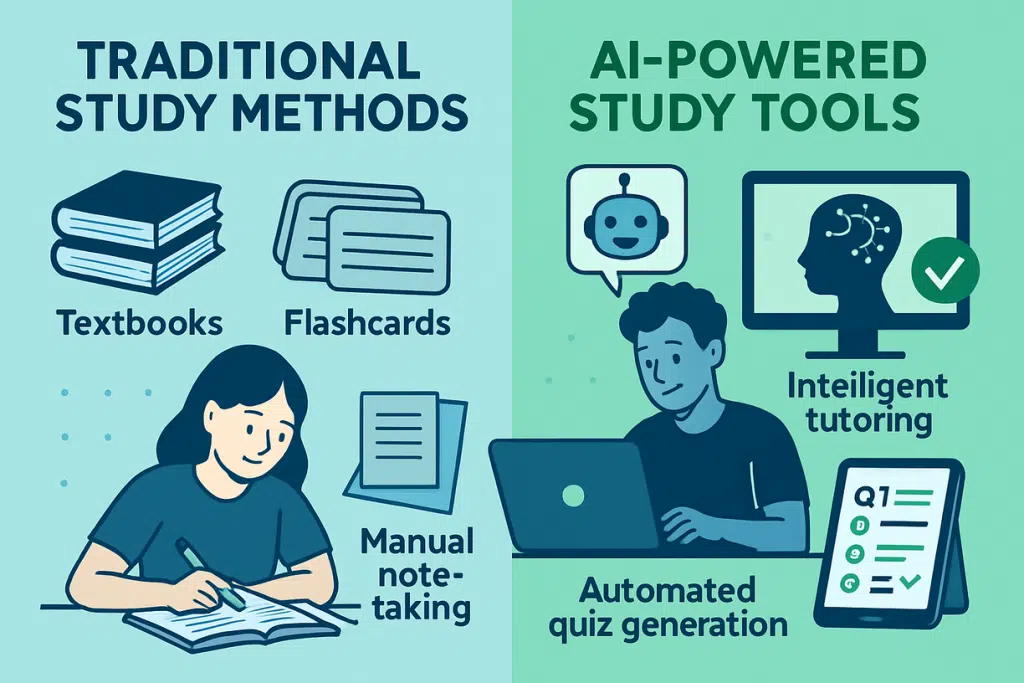
The current generation of AI study tools represents a quantum leap beyond simple digital flashcards or searchable PDFs. These sophisticated systems can:
- Generate personalized practice questions based on your learning patterns
- Provide step-by-step explanations tailored to your comprehension level
- Identify knowledge gaps before they become problematic
- Create customized study plans that adapt to your progress
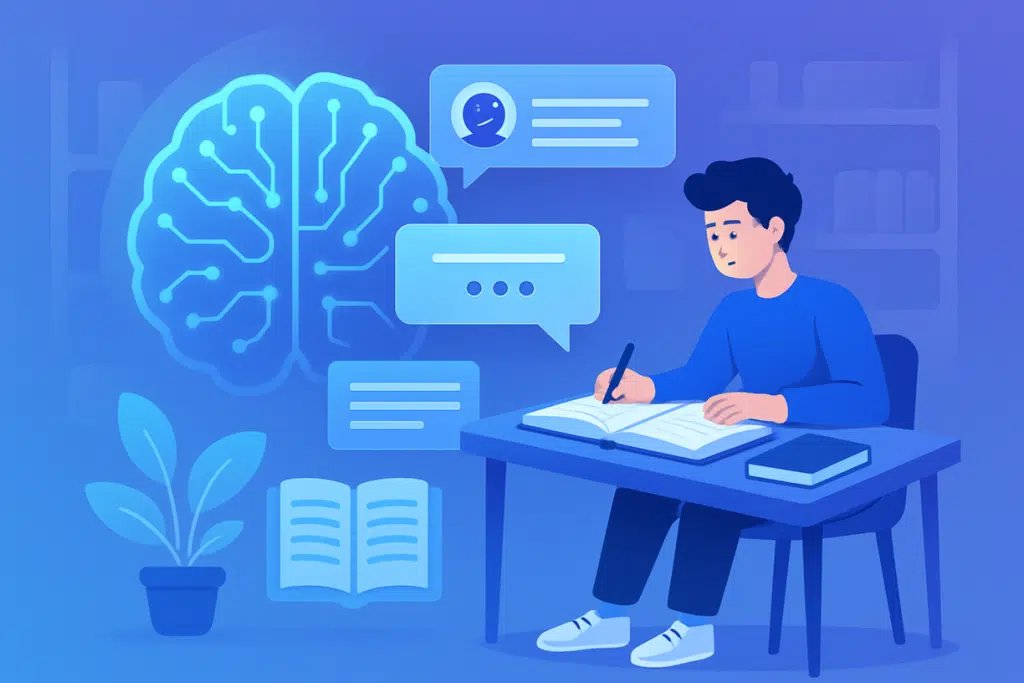
- Simulate one-on-one tutoring with conversational interfaces
- Transform dense textbook material into engaging, digestible formats
This isn’t just automation—it’s augmentation of human learning capabilities through artificial intelligence.
Categories of AI Study Tools and Their Applications
AI Tutors and Explanation Engines
These conversational AI systems can explain complex concepts, answer questions, and provide guidance similar to a human tutor.
Best uses:
- Breaking down difficult concepts into simpler components
- Providing alternative explanations when you’re stuck
- Answering specific questions during independent study
- Reviewing material before exams
Examples: Khan Academy AI Tutor, Socratic by Google, Wolfram Alpha, Jotverse
Potential pitfalls: Over-reliance can prevent development of independent problem-solving skills; explanations may sometimes oversimplify complex topics.
Content Generation and Summarization Tools
These AI systems can generate study notes, summaries, outlines, and even draft essays based on source material or prompts.
Best uses:
- Creating initial study outlines to build upon
- Summarizing dense reading material for review
- Generating practice questions from your notes
- Brainstorming essay structures and arguments
Examples: Notion AI, Quillbot, Scholarcy
Potential pitfalls: Using AI-generated content without critical evaluation or personal input can lead to shallow understanding and potential academic integrity issues.
Adaptive Learning Systems
These platforms use AI to create personalized learning paths that adjust to your performance, focusing more time on areas where you need improvement.
Best uses:
- Efficient review of large volumes of material
- Identifying and addressing knowledge gaps
- Preparing for standardized tests
- Mastering foundational concepts
Examples: ALEKS, Duolingo, Cerego, Jotverse
Potential pitfalls: The algorithmic approach may not always align with your personal learning style or the specific requirements of your courses.
While Jotverse does include some features from the AI Tutors and Explanation Engines category—such as conversation-like interaction—it goes beyond explanation and question-answering. Its focus on progress tracking and personalized reinforcement puts it more squarely in the Adaptive Learning Systems camp.
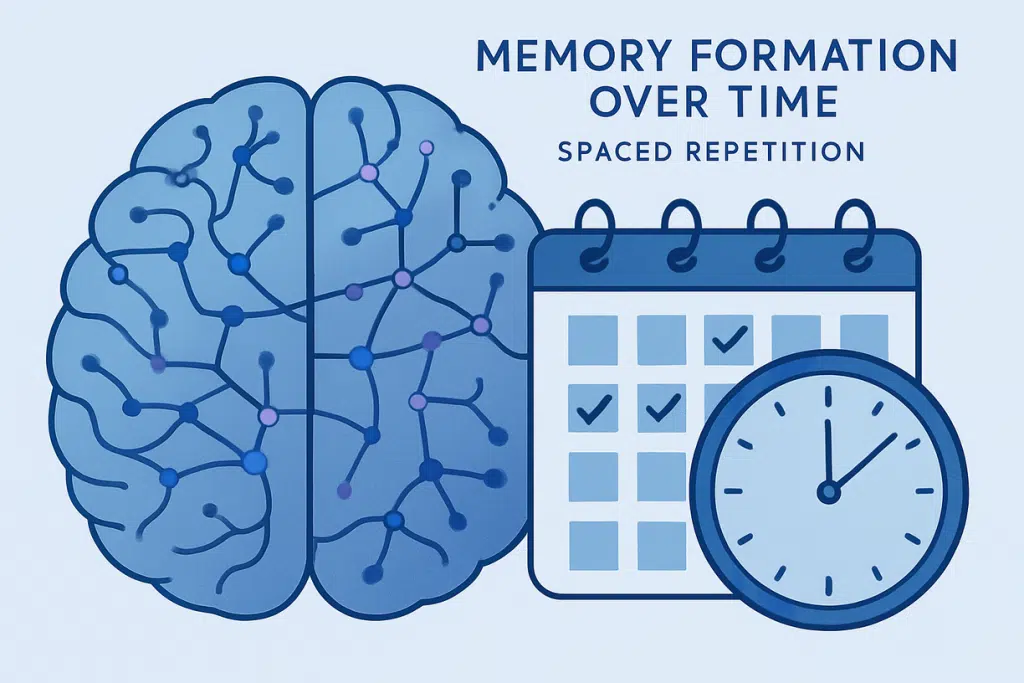
AI-Enhanced Flashcards and Spaced Repetition
These tools use AI to optimize traditional spaced repetition systems, predicting when you’re likely to forget information and scheduling reviews accordingly.
Best uses:
- Memorizing terminology, formulas, and facts
- Long-term retention of core concepts
- Language learning
- Medical and law exam preparation
Examples: Anki with AI plugins, RemNote, SuperMemo
Potential pitfalls: Focus on recall can sometimes come at the expense of deeper conceptual understanding.
Ethical and Effective Use of AI Study Tools
The power of AI study tools raises important questions about academic integrity and genuine learning. Here’s how to use these tools ethically and effectively:
The Augmentation Mindset vs. The Automation Mindset
Augmentation Mindset: Using AI to enhance your thinking, challenge your understanding, and accelerate your learning while maintaining personal engagement with the material.
Automation Mindset: Using AI to complete assignments with minimal personal effort or understanding, essentially outsourcing your learning to the algorithm.
The key to ethical and effective use lies in adopting an augmentation mindset, where AI serves as a collaborator in your learning journey rather than a replacement for your own intellectual effort.
Practical Guidelines for Ethical AI Use
For Content Creation
- Use AI to generate initial drafts or outlines, then substantially revise and expand with your own analysis
- Always critically evaluate AI-generated content against course materials and your own understanding
- Be transparent with instructors about AI tool usage when appropriate
- Never submit AI-generated work as your own without significant personal contribution
For Problem-Solving
- Use AI to check your work after attempting problems independently
- Ask AI to explain concepts, then try to rephrase the explanation in your own words
- Use AI to generate similar practice problems rather than solving your actual assignments
- Focus on understanding the process, not just obtaining answers
For Research
- Use AI to help identify relevant sources and summarize background information
- Verify all AI-provided information against reliable academic sources
- Use AI to brainstorm research questions and approaches, but develop your own critical analysis
- Maintain proper citation practices for all sources, including AI-assisted research
Maximizing Learning While Using AI Tools
The goal of using AI study tools should be to enhance learning outcomes, not just to complete assignments more quickly. These strategies help ensure you’re gaining genuine knowledge and skills:
The Feynman Technique with AI
- Study a concept using traditional methods and AI assistance
- Attempt to explain the concept in simple terms without AI help
- Identify gaps in your explanation
- Return to study materials to address those gaps
- Repeat until you can explain the concept clearly and completely
This approach ensures you’re developing true understanding rather than relying on AI-generated explanations.
The Prediction-Feedback Loop
- Before using AI for explanation or problem-solving, write down your own prediction or attempt
- Compare your approach with the AI’s solution
- Analyze differences and similarities
- Reflect on what you’ve learned from the comparison
- Apply insights to your next attempt
This method turns AI into a feedback tool rather than a replacement for your own thinking.
The Deliberate Practice Framework
- Identify specific skills you want to develop
- Use AI to generate targeted practice opportunities
- Engage in focused practice with minimal AI assistance
- Seek AI feedback on your performance
- Adjust your approach based on feedback
- Repeat with increasing difficulty
This structured approach ensures you’re building skills progressively rather than letting AI handle challenging tasks.
The Future of AI in Education: Preparing for What’s Next
As AI study tools continue to evolve, students who develop effective strategies for working with these technologies will have significant advantages. Here’s what to expect and how to prepare:
Emerging Trends in AI Education Tools
- Multimodal learning systems that combine text, audio, visual, and interactive elements
- Emotion-aware tutoring that responds to frustration, confusion, or engagement
- Collaborative AI that facilitates group learning and project work
- Extended reality integration that creates immersive learning experiences
- Continuous assessment that replaces traditional testing with ongoing evaluation
Building AI-Resistant Skills
While AI can handle many routine cognitive tasks, certain skills remain distinctly human and increasingly valuable:
- Critical thinking and evaluation of AI-generated content
- Creative synthesis of ideas from multiple sources
- Ethical reasoning about complex situations
- Interpersonal communication and collaboration
- Self-directed learning and metacognitive awareness
Focusing on these areas ensures you’re developing capabilities that complement rather than compete with AI.
Finding the Right AI Study Tools for Your Needs
With hundreds of AI study tools available, selecting the right ones requires careful consideration:
Evaluation Criteria for AI Study Tools
- Alignment with learning objectives: Does the tool support your specific educational goals?
- Transparency of operation: Can you understand how the AI generates its responses?
- Customization options: Can you adjust the tool to match your learning preferences?
- Data privacy policies: How is your learning data being used and protected?
- Integration with existing workflows: Does the tool work with your current study methods?
- Cost and accessibility: Is the tool affordable and available when you need it?
Starting Small and Scaling Up
Rather than adopting multiple AI tools simultaneously, start with one tool for a specific purpose:
- Identify a specific learning challenge (e.g., understanding complex concepts, retaining information, organizing notes)
- Research AI tools designed for that challenge
- Test the tool on a limited basis
- Evaluate its impact on your learning
- Gradually incorporate additional tools as needed
This measured approach prevents overwhelm and ensures each tool adds genuine value to your learning process.
Balancing AI Assistance with Independent Learning
The most successful students find a balance between leveraging AI capabilities and developing their own intellectual skills. This balance typically shifts throughout the learning process:
The Learning Progression Model
Novice Stage: Higher AI support for foundational concepts and skill-building
- Use AI for detailed explanations and guided practice
- Focus on building basic understanding and confidence
Intermediate Stage: Balanced approach with selective AI assistance
- Use AI to overcome specific obstacles and enhance efficiency
- Develop independent problem-solving strategies
Advanced Stage: Minimal AI support with focus on creative application
- Use AI primarily as a reference and verification tool
- Emphasize original thinking and complex applications
This progressive reduction in AI dependence ensures you develop genuine mastery while benefiting from AI support when appropriate.
Interactive learning platforms like Jotverse exemplify this balanced approach, providing AI-powered assistance while encouraging active engagement and genuine understanding through personalized learning experiences.
Becoming an AI-Enhanced Learner
The students who will thrive in the age of AI education are neither those who reject these tools entirely nor those who rely on them uncritically. Rather, success will come to those who thoughtfully integrate AI into their learning processes while maintaining ownership of their education.
The goal isn’t to outsource your education to algorithms, but to leverage these powerful tools to become the best student—and thinker—you can be.