

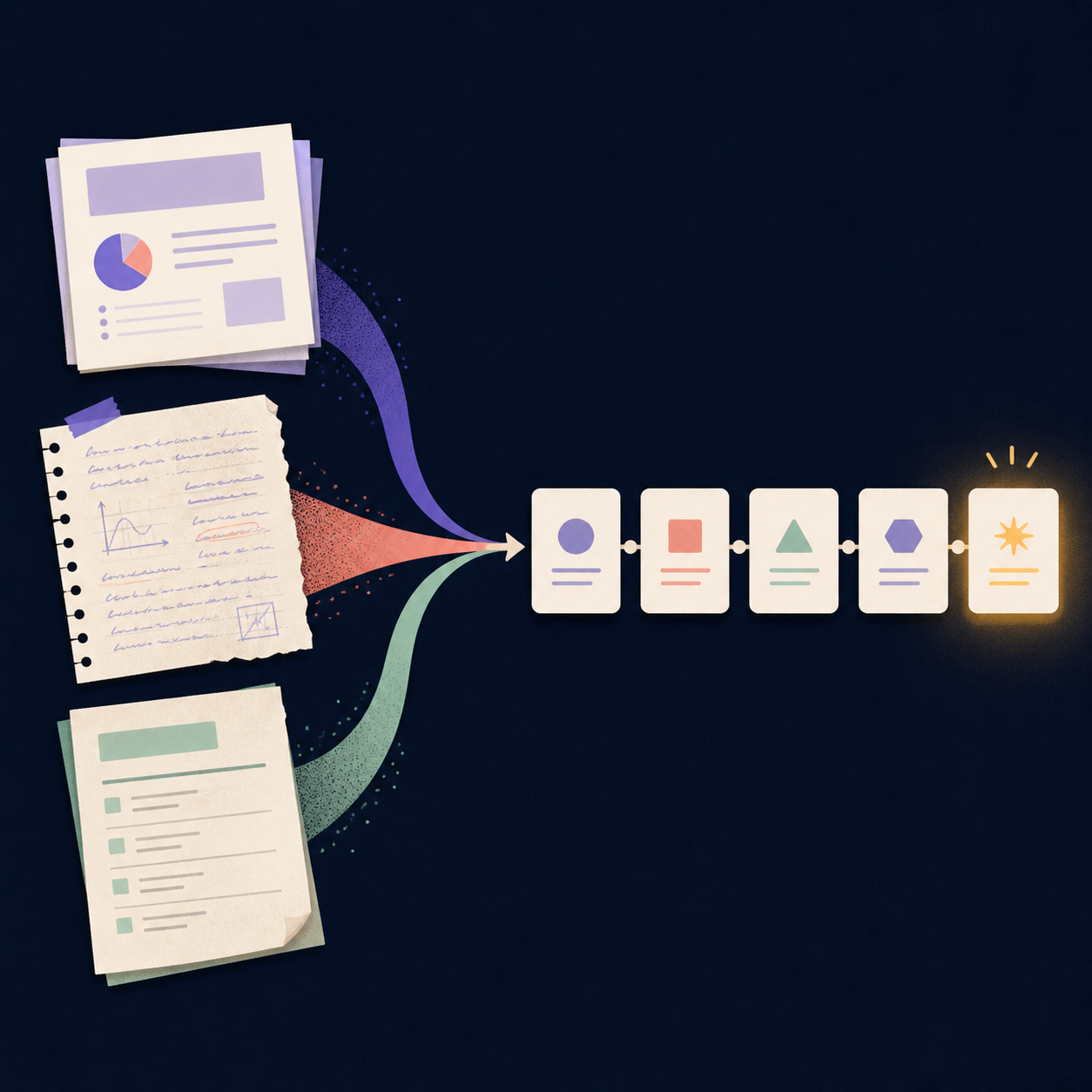
Having more material is not the same as having a plan. A lecture deck tells you what was covered. Notes capture what seemed important that day. A syllabus tells you what the course expects over time. When an exam is approaching, opening all three can create the same question: what should I do first?
The answer is not to reread everything in the order it landed in your folder. Build a short map of the course, use it to choose one next session, then check what you can actually explain.
Start with one course map, not three separate piles
Put the syllabus, lecture slides, notes, readings, problem sets, and assessment dates where you can see them together. You are not trying to make a perfect archive. You are trying to answer four practical questions:
- What topics can appear on the next assessment?
- Which topics depend on earlier ideas?
- Which material explains or practises each topic?
- What evidence would show that I understand it?
Make a simple list with one row per topic or unit. Use the syllabus to define the broad units, the slides to identify the ideas actually taught, and notes or assignments to flag emphasis and practice.
| Topic or unit | Material to use | Depends on | Evidence of understanding |
|---|---|---|---|
| enzyme kinetics | Lecture 5 slides, lab notes, practice questions | reaction rates, graphs | Explain the curve and solve a new question |
Keep it rough. A useful first map is better than a beautifully formatted one that never turns into study time.
Put the assessment date beside the material
A syllabus often carries the information that individual notes do not: assessment dates, unit order, weighting, and required readings. Add the next assessment date and the relevant units to your course map.
Then mark each topic as one of these:
- Needed now: likely to be assessed soon or necessary for the next unit.
- Foundation: needed to understand a current topic, even if it is older.
- Later: important, but not the best use of the next study session.
This protects you from a common trap: beginning with the easiest or newest document because it is open, rather than the concept that unlocks the most work.
Find dependencies before scheduling hours
In difficult courses, topics are rarely independent. You may struggle with a physics problem because the algebra step is shaky, or with a pharmacology topic because the underlying mechanism is unclear. If a later topic keeps feeling impossible, ask: what does this assume I already know?
Draw a small arrow from the later topic to the prerequisite. You do not need a full curriculum diagram. Two or three dependency arrows are enough to reveal whether your next step should be a newer lecture or a missing foundation.
This is also where course-grounded guidance is more useful than generic motivation. The right next step comes from the relationship between the material, the assessment, and the gap—not from a larger daily-hour target.
Turn the map into the next 45–90 minutes
Do not schedule a week as “study chemistry” or “review notes.” Those labels are too broad to start. Turn one priority topic into a session with a visible finish line:
- Choose one topic. Pick a needed-now topic or its prerequisite.
- Choose one source. Open the lecture section, worked example, reading passage, or question set that introduces it.
- Write one question. For example: “Can I explain why this formula changes here?” or “Can I identify the mechanism without looking?”
- Practise from memory. Close the source and explain, solve, sketch, or answer.
- Mark the gap. If you cannot do it, name the exact step that broke down and make that the next small task.
This sequence gives your plan a feedback loop. You are not checking off pages; you are learning which concept needs another pass.
Use your notes as clues, not as the whole plan
Notes are valuable because they often capture examples, warnings, and the instructor’s emphasis. But notes can also be incomplete or organised around a single class meeting. Match each note section to a topic on the course map instead of treating it as a separate study list.
If your notes say “review this diagram” or “common exam mistake,” add it under the relevant topic as a practice cue. If a note does not connect to an assessment-relevant topic yet, leave it in the later column. That is not ignoring it; it is deciding deliberately.
Review the plan after every study session
At the end of a session, update only three things:
- What you can now explain or solve without help.
- The exact gap that is still blocking you.
- The next source or question you will open.
This is how a study plan stays realistic when a course moves faster than your original calendar. A plan that changes after evidence is better than a rigid schedule built from optimism.
When the pile still feels too big
If you have weeks of material, begin with the next assessment and one representative topic. You do not need to sort every file before you start learning. Build the map while you work:
- Add a topic when it appears in the syllabus or assessment scope.
- Attach the one or two materials that help with it most.
- Record the prerequisite only when it changes what you should study next.
For a catch-up workflow, see How to Catch Up When You’re Behind in a Difficult College Course. That guide starts with prioritising a backlog; this one gives the material-to-session structure that makes the priority actionable.
Use the material to decide the next step
The goal is not a colour-coded spreadsheet. It is to go from “I have slides, notes, and a syllabus” to “I know which concept I am testing in the next hour.”
Jotverse is built for that same moment: students can bring their own course material into a private tutor context, ask course-specific questions, and use guided study sessions to decide what to work on next. It should complement course staff and your own practice, not replace either.