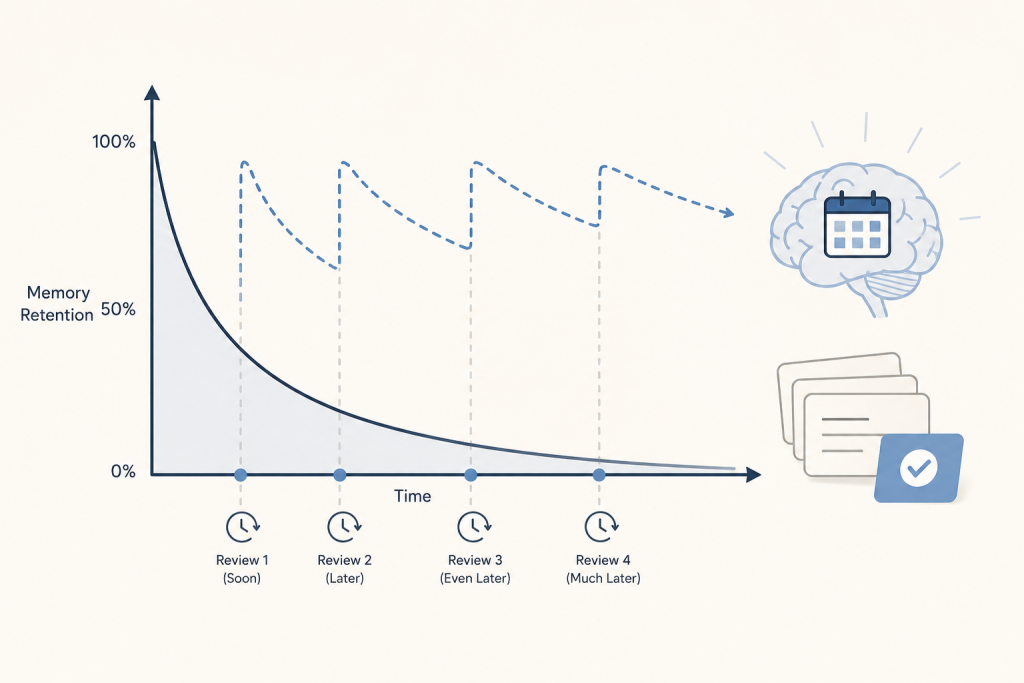
Ask any student or teacher: you study something, and without reinforcement, most of it disappears within days. Most people have experienced this. Fewer know there are 140 years of research explaining exactly why. Hermann Ebbinghaus mapped it first, in 1885, and called it the forgetting curve. The research has been replicated so many times since that it barely counts as a finding anymore; it is just how memory works.
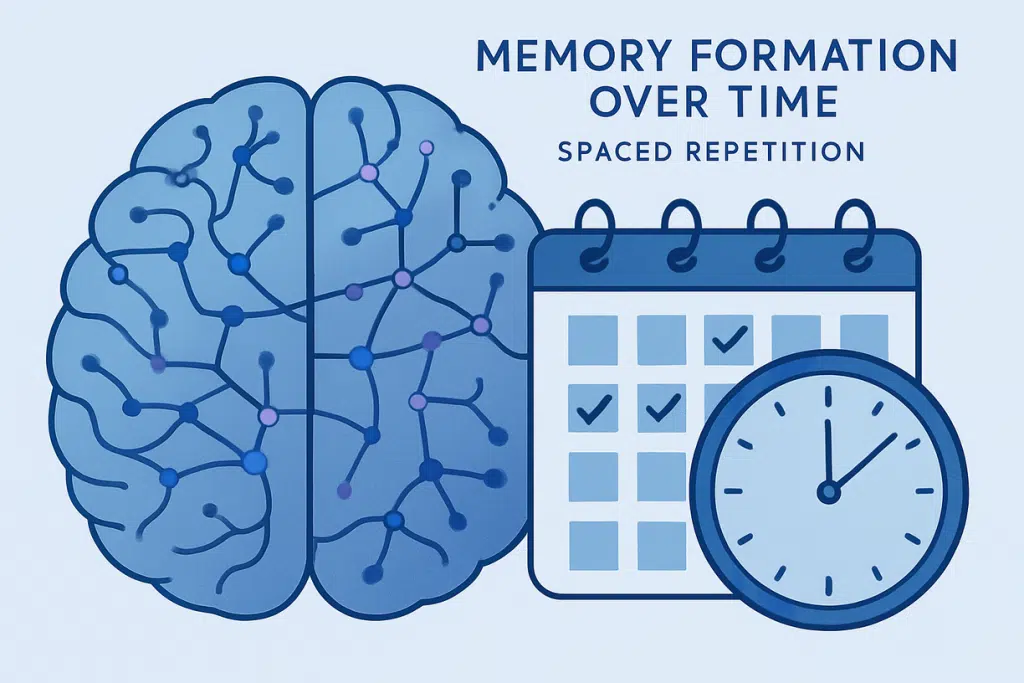
The fix is equally well-established: spaced repetition, the practice of returning to material at increasing intervals, consistently outperforms cramming for long-term retention. Hundreds of experiments across subjects, ages, and contexts have reached the same conclusion. Multiple large-scale reviews of study techniques rate it among the highest-utility strategies available to students; cramming, which is what most students default to, ranks near the bottom. The spacing effect is not a niche insight. It is the closest thing to a consensus that learning science has.
And yet most students still cram. Not because they haven’t heard of spaced repetition; because acting on it is totally tedious. You have to make the flashcards, write the quiz questions, track what you’ve reviewed and when, and then actually sit down to do it again before it feels urgent. For a student balancing four courses and a part-time job, that overhead is a real cost. And even the most motivated student tends to go back to material they already feel comfortable with, because comfort feels like progress. Spaced repetition asks you to do the opposite: return to things that feel uncertain, at exactly the moment when other work is competing for your attention.
For teachers and tutors, the problem is similar. On top of in-person teaching, designing revision materials and building spaced review into a curriculum takes hours that don’t exist in a contracted working week. Psychologist Frank Dempster called this out in 1988: the spacing effect as “a case study in the failure to apply the results of psychological research.” Thirty-five years later, the gap was largely still there.
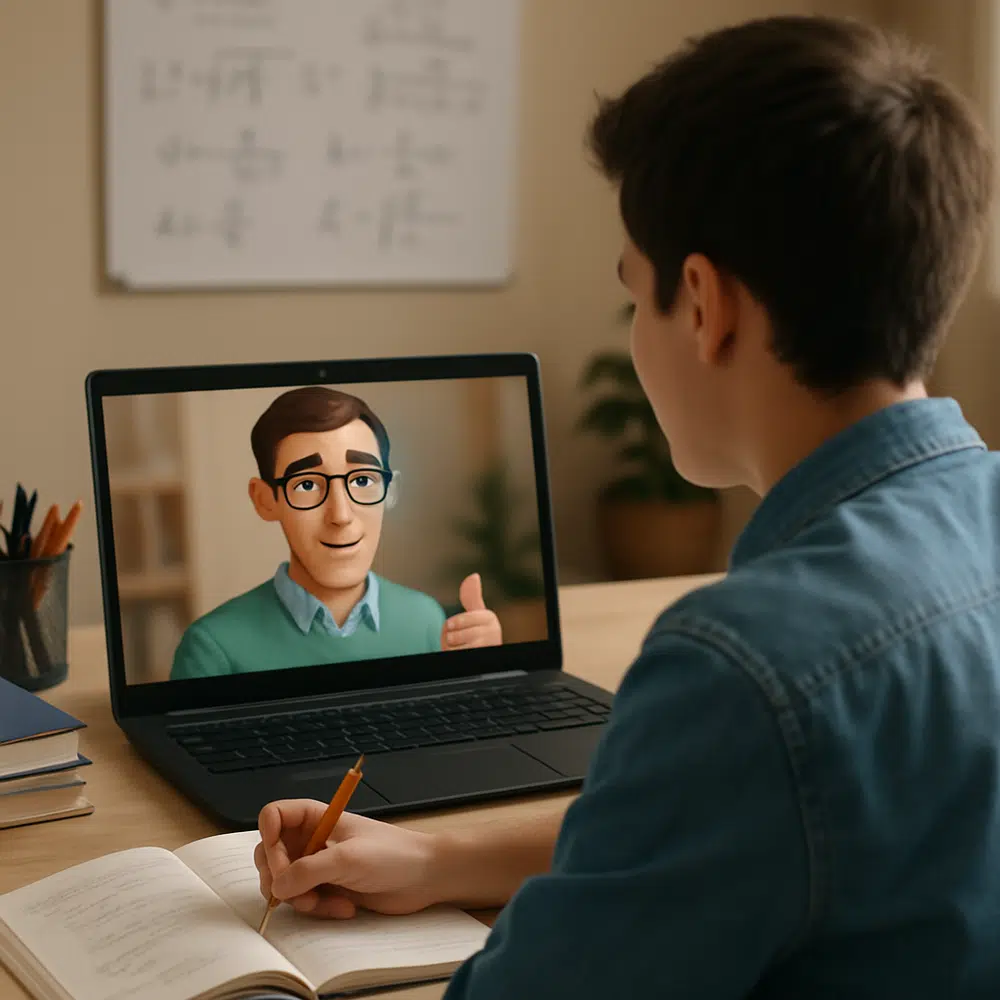
Then came a study that got people’s attention. In fall 2023, researchers at Harvard ran an experiment comparing a carefully designed AI tutor against a well-taught active learning classroom. Students learned more than twice as much in less time with the AI tutor. The AI didn’t invent a new pedagogy; it made an old one scalable: pacing material to the individual, keeping the student actively retrieving rather than passively consuming, and adapting at every step. These are exactly the conditions under which spaced repetition works. We wrote about the study in detail here; it’s worth a read.
Many students have both the motivation and the materials to study, but the structure around them doesn’t give them what Ebbinghaus prescribed 140 years ago: the right material coming back at the right moment, in a form that asks them to actively reconstruct it rather than passively recognize it. That is a design problem, not a student problem.
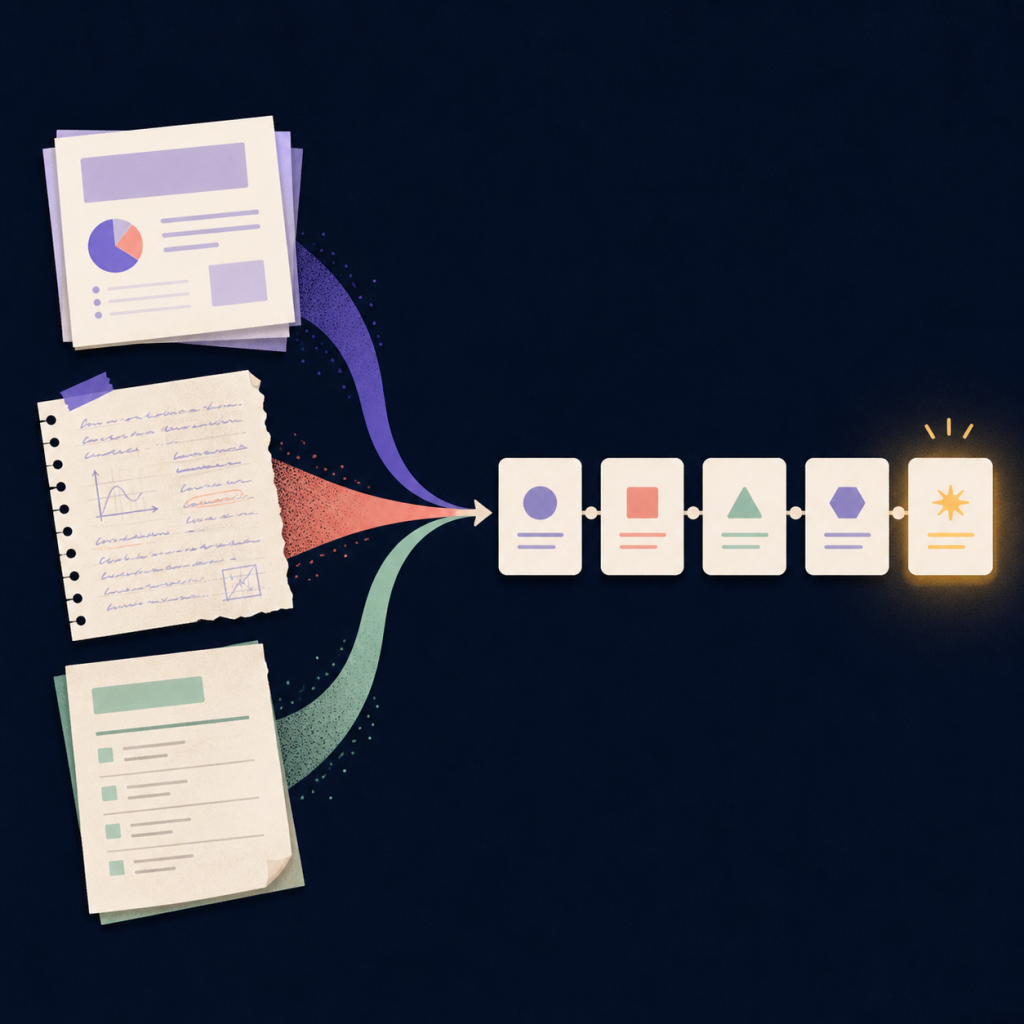
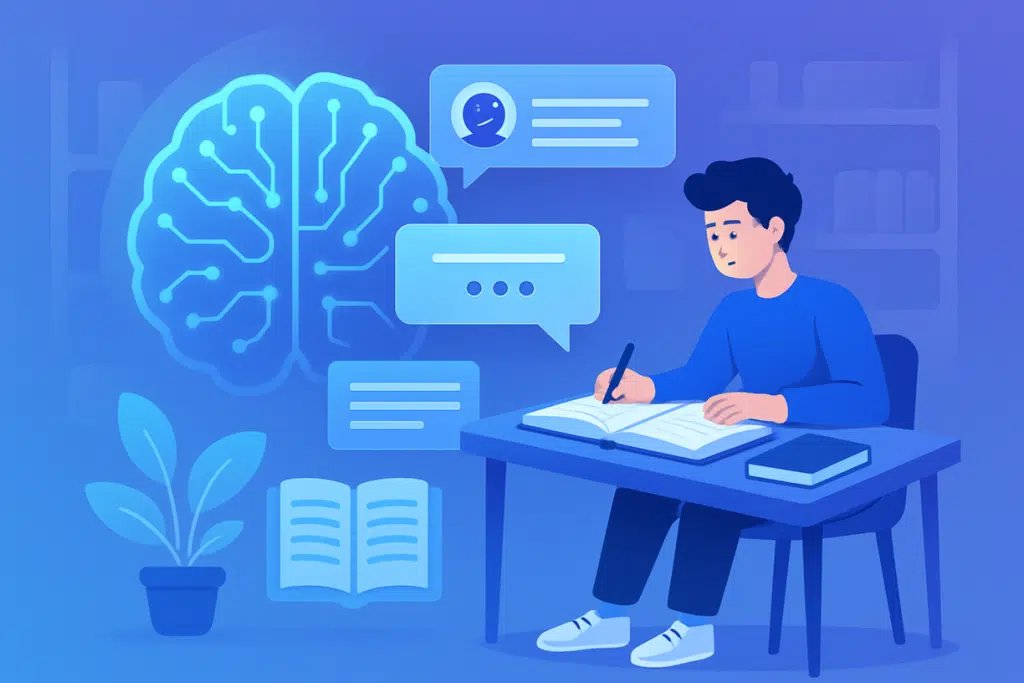
Jotverse is built around this design principle. Upload your materials: lecture notes, textbooks, readings, transcripts. The AI tutor built around spaced retrieval practice structures them into a personalized learning framework that brings concepts back when they need to come back, asks questions that push you to retrieve rather than re-read, and tracks your progress in a form you can actually use. It’s not a replacement for a teacher. But it is the thing a teacher has always wanted: a way to give every student the kind of attention that only used to be possible one-to-one.
Science is 140 years old. Jotverse is built to finally deliver it at scale.
Author
Mariana Razina
Sources
Cepeda, N. J., Pashler, H., Vul, E., Wixted, J. T., & Rohrer, D. (2006). Distributed practice in verbal recall tasks: A review and quantitative synthesis. Psychological Bulletin, 132(3), 354–380.
Dempster, F. N. (1988). The spacing effect: A case study in the failure to apply the results of psychological research. American Psychologist, 43(8), 627–634.
Dunlosky, J., Rawson, K. A., Marsh, E. J., Nathan, M. J., & Willingham, D. T. (2013). Improving students’ learning with effective learning techniques: Promising directions from cognitive and educational psychology. Psychological Science in the Public Interest, 14(1), 4–58.
Ebbinghaus, H. (1885/1913). Memory: A contribution to experimental psychology (H. A. Ruger & C. E. Bussenius, Trans.). Teachers College, Columbia University.
Kestin, G., Miller, K., Klales, A., Milbourne, T., & Ponti, G. (2024). AI tutoring outperforms active learning. Research Square. https://doi.org/10.21203/rs.3.rs-4243877/v1